Communicating with Multicultural Audiences
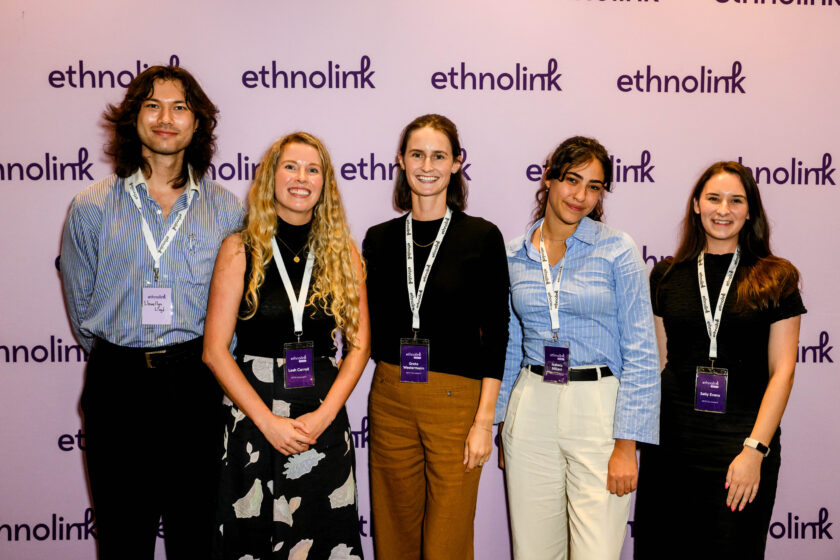
Late last month, Sally, Leah, Greta, Isabela and Llewelyn attended the 2026 Ethnolink Summit in Sydney – Australia’s largest event on multicultural communications. The summit brought together a diverse range of speakers from government, to not-for-profits, community organisations and industry experts who design and deliver communications for multicultural audiences. A key theme was moving beyond translation alone and using plain English in communications. When a resource doesn’t reflect people’s realities or feels disconnected from their everyday lives, it won’t be used irrespective of how important it is.
In our own work, we regularly engage with diverse stakeholder groups and understand the importance of ensuring our approaches are inclusive and accessible. Below Sally, Leah, Greta, Isabela and Llewelyn reflect on the presentations and themes that resonated most with them, and how these learnings will be carried forward into evaluations.
Sally: A word that resonated with me and appeared in several of the presentations was ‘trust’. This is a theme that we see regularly in our work that engaging with communities. Carlo Krikowa, Program and Policy Manager at AMHC discussed this theme in his presentation ‘The Collaborative: Lost and Found in Translation’. He discussed the systemic barriers multicultural communities can face in accessing services and emphasised the importance of trust, in some cases the messenger can be just as important as the message. Trust is not automatic and often takes time to build through sustained relationships. In our project work, we don’t always have those established relationships or the time to curate them over many years. We can still apply these considerations to ensure our engagement is effective and meaningful. The nuance and the detail of our messaging matter, in addition to listening to and working with those who bring existing knowledge and existing partnerships.
Leah: I would be interested to know if, since 2020, there has been a conference without at least one presentation about AI. This year’s Ethnolink conference was no exception, featuring a presentation on Language AI and multicultural communications by Ethnolink’s founders and CEO, Costa Vasili. As someone with a keen interest in the interaction between new technologies and workplace relations, this presentation immediately piqued my interest. Like so many industries, AI is offering the promise of productivity and speed for a lower cost. For many who operate in environments constrained by timelines and budgets, AI seems to promise the opportunity to communicate with a wider audience, including people who speak diverse languages. As an evaluator, the promise of being able to bring in more voices and perspectives is exciting. But of course, like all the work we do, leveraging new tools comes with understanding the risks and rewards, and the ethical implications of what we do. Costa Vasili’s presentation highlighted that AI could help produce content and words, but humans add context and understanding. My key takeaway was that, like many new technologies, AI can support human interaction, but it will not replace the connection and understanding that comes from meaningful engagement with communities. As an evaluator, that will always mean going beyond the translation of communications such as data collection tools and transcripts, to considered engagement with the communities whose voices we want to include in our work.
Greta: What stood out to me from the Ethnolink summit was hearing the perspectives and experiences of engaging with multicultural communities through the presentations and the roundtable discussion with other attendees. We discussed common barriers to effective communication with multicultural communities, sharing a range of perspectives from diverse sectors. As evaluators, we often have a unique perspective where we may not always face every challenge directly, but we can draw on the collective experiences of our clients from the many evaluations we have conducted. This meta perspective allows us to reflect on common issues experienced in community engagement. And of course, we also engage with communities ourselves, which adds another level of understanding. For me, the conference affirmed the importance of relationship building and how valuable it is to learn from each other’s experiences. Overall, it was a reminder that collaboration and reflection are essential to improving how we connect with and support multicultural communities.
Isabela: As one of the few staff at ARTD who was born abroad and has English as her second language, my experience at the Ethnolink conference was slightly different. In his opening keynote speech, Marc Orlando said “Aiming to be understood is good, but aiming to connect with the people we want to communicate with is even better” – and I could not agree more. Having lived in three different countries with three different languages over the course of my life, I’ve made many linguistical mistakes. As a foreigner, your tone and social cues may differ and sometimes even nailing a joke can be hard. I often found that the people I was truly able to connect with, including in my professional life, have been people who didn’t just listen to what I’ve said, but questioned the lenses of their own interpretation before attributing meaning. From a policy perspective, words are the vehicle through which connection happens. If government wants to connect multicultural communities, it needs to question its own idea of ‘effective communication’ to speak in a language communities will not just understand, but resonate with. As Nelson Mandela said “If you talk to a man in a language he understands, that goes to his head. If you talk to him in his language, that goes to his heart”.
Llewellyn: As a recent graduate and new member of ARTD, the Ethnolink Summit was the first conference I’ve attended in my professional career. I was impressed by the variety of topics, and the range of professional and academic backgrounds represented. One key theme that stood out was the importance of language; not just the languages we speak, but the words we choose. The first speaker, Professor Marc Orlando, highlighted the value of accessible language. He outlined how we must use words that not only convey our messages clearly but also help them resonate emotionally with our audiences. He explained how complex language, like technical terms, abbreviations, and jargon, can unintentionally exclude people, especially those who aren’t experts in the field. Having spent the last few years in academic settings, this really resonated with me. While technical language has its place, I’ve seen how challenging it can be for those outside the discipline. Moving forward, I plan to be more thoughtful about the language I use, making sure my communication is clear and impactful for everyone.
Image source: Ethnolink Summit 2026