Give To Gain: International Women’s Day 2026
This year’s International Women’s Day theme, ‘Give to Gain’, highlights that supporting women through resources, knowledge and time, creates new opportunities and builds stronger communities. Supporting women also means challenging stereotypes, calling out discrimination, questioning bias, and celebrating women’s achievements.
This theme is especially relevant to our work in evaluation. Making space for women’s voices and perspectives helps drive meaningful progress toward gender equality in our field. At ARTD, over 90% of our directors and senior leaders are women, which naturally shapes the conversations we have about what structural equality looks like.
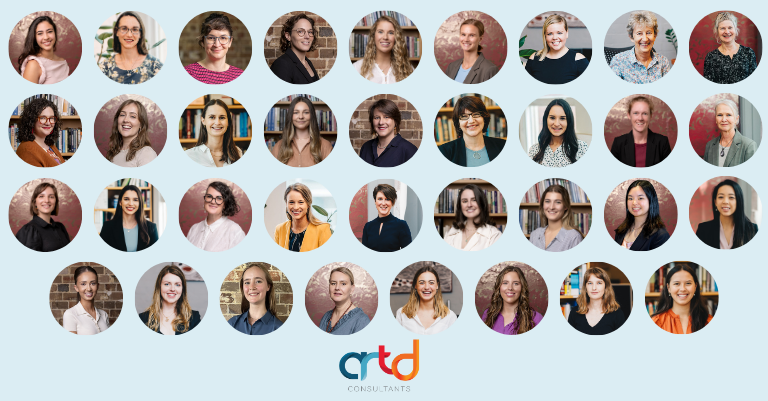
In response to this year’s theme, we asked members of our team to share their advice for women starting in evaluation, and to reflect on their experience in a workplace that supports and empowers women.
Naomi: Being new to the industry, I’ve found myself feeling unsure or thinking I don’t have much to add, especially being surrounded by talented and experienced people. If I’ve learned anything, it’s that everyone starts somewhere. To other women just starting out my advice would be don’t be afraid to have a go. It’s easy to convince yourself you have nothing new to offer in a field full of knowledgeable people, but your perspective is always valuable, no matter how new you are. If you bring curiosity and a willingness to learn, you’ll always find you have something unique to add. Trust yourself, and don’t be afraid to put your ideas out there, even if your voice shakes a little at first, because you always come away better for it.
Chloe: This year’s theme really resonates with me. I think knowledge sharing is something a lot of people struggle with, especially those studying or early in their careers. When your fresh in, there’s an unspoken tendency to keep what you learn to yourself, in the hopes you gain an edge over everyone else. While this can look like competitiveness, for many women it stems from a fear of being overlooked or undervalued. This year’s theme encourages us to rethink that instinct and focus on what we gain when we give openly. My journey into evaluation was a shift. Coming into a new field, I expected that same guarded approach to knowledge, particularly in such a specialised and complex industry. I’m very proud to be part of an organisation where training and collaboration is genuinely valued. Our knowledge isn’t power because it’s kept, but because of the people who share it.
Louise: On International Women’s Day, I want to celebrate the impact that women leaders have had on my own career journey. Before moving into evaluation, I spent almost a decade in hospitality – a field where management was often male-dominated. Making a career shift later in life, it’s been inspiring to join ARTD and see so many strong female role models in senior positions. Seeing women lead decision-making not only shows what’s possible for progression but also creates a more inclusive and supportive environment for everyone. While diverse leadership benefits all of us, having women visible in these roles has been particularly meaningful to me. My advice would be to be gentle with yourself when starting out. There’s a lot to learn, and you’ll find yourself pulled into projects at all different stages, which can feel overwhelming. It’s normal to get frustrated but that’s all part of the learning process. As I continue my journey, I hope to one day become the kind of role model I’ve been lucky enough to look up to here – supporting and encouraging others as they navigate their own journeys.
Kate: I’ve been enormously lucky to benefit from the knowledge and coaching of very experienced and wise women and men at ARTD over the years. What I’ve really appreciated though from my women coaches is their understanding and support strategies to help overcome some of the things that come with being socialised female, including challenging imposter syndrome!
Ash: For many women, progression into leadership can feel like a balancing act between expectation and authenticity. The pressure not to show emotion can feel like disconnect between the person you are, and the associations you have with how a leader ‘should’ behave. Previously I have thought showing emotion is a deficit, but over the years it’s shaped my leadership style and ability to connect more thoughtfully with people. Bringing your authentic self to work builds an environment for others to do the same, shaping how people feel about contributing and collaborating. With leaders like Jacinda Ardern openly talking about sensitivity in leadership, embracing these qualities has become a tool for understanding rather than something to work around.
Amanda: At ARTD, we have a very female led workplace. Having so many women around, each with their own style and experience, means there’s always someone to help you work through a difficult conversation, a conflicting decision, or navigating something unfamiliar. One of the most valuable things I’ve taken from our leaders is learning how to reflect on what matters to me and feeling comfortable making choices that reflect that. It’s the first place I’ve worked where you’re asked “What do you want to do? What do you enjoy?”, which is a harder question to answer than it sounds for women conditioned to prioritise the needs others before their own.