
Lessons and ongoing challenges: reflections from 50 years of Indigenous Leadership in Disaster Resilience
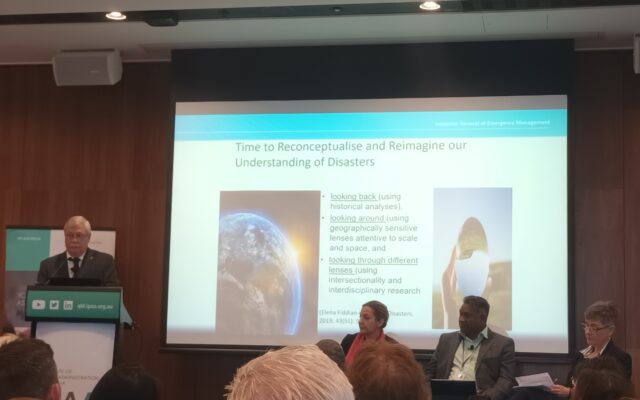
I attended an excellent Australian Institute for Disaster Resilience (AIDR) webinar on 7 June 2026, exploring First Nations leadership in disaster response and recovery as part of NAIDOC Week celebrations. National NAIDOC Week is a time to celebrate and honour the history, cultures, and achievements of Aboriginal and Torres Strait Islander peoples. Aligned with this year’s theme, “50 Years of Deadly,” a panel of presenters facilitated by Dr Bhiamie Williamson highlighted 50 years of mob-led resilience and the history of First Nations leadership in emergency response and recovery[1].
Bhiamie led us through a history of First Nations leadership in disaster management (complete with some fascinating archival materials). Starting from the 1974 Brisbane floods, he highlighted the active role Aboriginal organisations have played since emergency management emerged as a field, providing relief and support, and advocating for the representation of Aboriginal interests in mainstream response and to official commissions and inquiries about major disasters.
Coral Lever, the CEO of First Nations Response, an organisation born during COVID-19 that tackles food insecurity, explained that disasters expose systemic gaps. She noted that in disasters, First Nations kinship networks frequently stand up supports before formal systems do, and that First Nations responses work to maintain local communications and protect each other amid systemic failures. Coral noted that this is not a modern ‘add-on’ to emergency management, but a time-tested leadership tradition in First Nations communities.
Coral made the point that despite strong community leadership, mainstream emergency management frameworks often fail to demonstrate trust in grassroots capacity and in the knowledge grassroots organisations have from working in the frontline of community, which is reflected in short-term funding cycles.
We also heard from Zoe Schultz, a Research Fellow with National Indigenous Disaster Resilience, Monash University, who presented on AUS WTREX, an intensive training course in fire management for Indigenous women that ran for the first time in Australia in 2025. Zoe shared some of the immediate outcomes for the women that attended in understanding the value of the wealth of knowledge they hold, and building their confidence that people wanted to hear from them. However, she also highlighted that one of the challenges is that while the participants are returning as changed women they are returning to unchanged places (in a male dominated sector), where there can be scarce support for Indigenous women leaders on the frontline.
Some reflections
The evaluations I’ve been doing over the last few years in the disaster management sector, as well as in systems change work have given me a healthy appreciation of how much continuous effort is required to build and maintain trust, cooperation, shared goals and mindsets within a system. If there’s anything I’ve learned from my work in the disaster sector it’s how important it is that efforts to do so be maintained during ‘peacetime’, but that often, once the ‘recovery’ phase is over, the funding can tend to be reallocated to other priorities and crises. This is challenging because relationships and collaboration capability between institutions, however embedded in process or formal agreements, are usually between key people. When there is no longer funding for contracts, institutional knowledge (lessons learned) and importantly relationships often leave with people.
The WTREX women’s challenges bringing their leadership confidence and capabilities back to their unchanged workplaces was a reminder of how positive outcomes achieved within one organisation or context can be eroded when they are brought into contact with an unchanged broader system. I left the webinar with a deeper understanding and appreciation of the history of Aboriginal and Torres Strait Islander leadership in emergency management, as well as some of the great First-Nation led projects and research currently happening across the PPRR cycle.
It also left me with some broader questions:
- what does effectively building trust between people and institutions look like in the pressurised context of responding to disasters and systemic failures?
- what sorts of evidence can grassroots organisations provide?
- what innovations are needed in how funders assess funding risk to speed up the recovery process and improve recovery outcomes?
- how can we elevate the value of relational outcomes and relational factors in recovery in disaster sector evaluations?
- how can we better ready workplaces, and equip people to have conversations that help them shift mental models within their work contexts as part of the model of development programs?
You can watch the recording at: NAIDOC Week webinar | Indigenous leadership in disaster resilience
[1] Bhiamie is the Program Lead of National Indigenous Resilience (NIDR) at Monash University, a research centre investigating the impacts major disasters have on Aboriginal and Torres Strait Islander people. NIDR conducts research, creates tools, resources and policies, and engages with policy makers and communities around the unique dimensions of Indigenous communities in relation to emergency management and community recovery.