AES Conference Day 3 – Travelling far
Cover image owner: Australian Evaluation Society
On the final morning of AES26, I sat with a hot laksa and an iced coffee and watched the morning sun sweep across Darwin. It was the perfect start to another day of all things evaluation. It felt right that a conference about making space and valuing place had gathered us on Larrakia Country, in a city that seems to ask you to slow down.
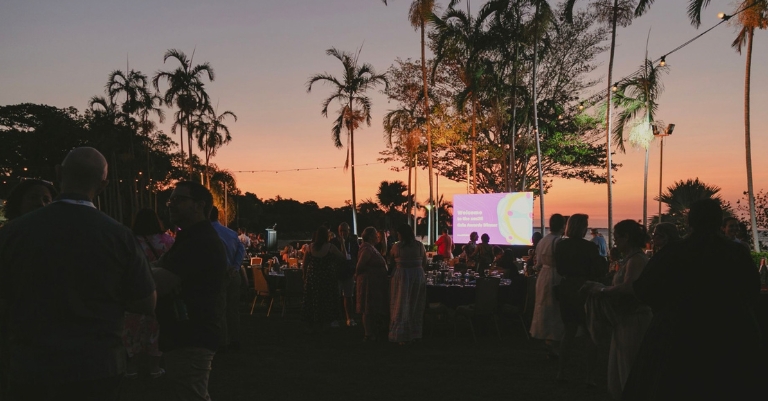
At the gala dinner, newly appointed AES Fellow Duncan Rintoul shared a line I keep coming back to as I reflect on the conference: if you want to travel fast, travel alone; if you want to travel far, travel together.
This message perfectly framed day 3 of AES26.
Jack Rutherford, Sophie Henness, Simon Alaba, Fergus Bailey, Jade Maloney, Paula Shaw, Stephanie Quail, Chloe Markulic, Amanda Taylor-Short and Abel Scopelliti at the AES Gala dinner. Image owner: Australian Evaluation Society
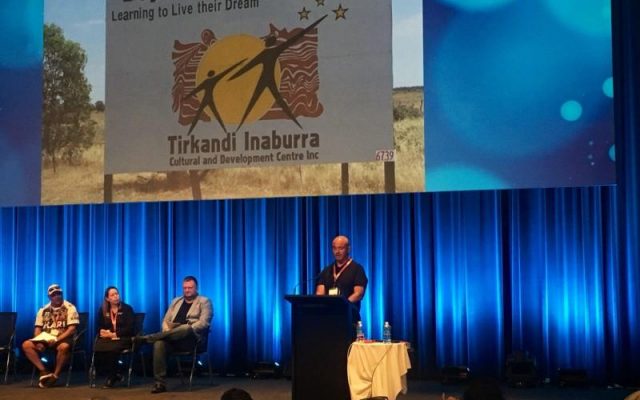
Selwyn Button opened the day with a reminder that data is not enough. You need conversations to understand what the numbers mean and to create change. This got me thinking about the conversations around the evidence. Data can get us somewhere quickly, but it takes people talking to each other to get anywhere that lasts. To go beyond the data is to go together, and to travel far.
The morning turned to a question the sector has been circling for a while: what does it mean to be an evaluator, and what might professionalisation look like?
A panel with Jade Maloney, joined by Tony Kiessler, Liz Wren, Nigel McPaul and Eleanor Williams commenced discussions on what it means to be an evaluator and how professionalisation might work within such a varied field. It was refreshing to hear both the promise and the risks. Done well, and supported by work to define quality evaluation that makes a difference and to update the ethical guidelines, professionalisation could support the sector, ethical practice, career pathways and connections between us. Done poorly, it could divide the work of evaluation, build barriers to emerging evaluators and distance the practice of evaluation away from its foundations of Indigenous ways of knowing, being and doing.
Reflecting on both professionalisation sessions, I found myself shifting my views constantly. Each perspective from the panel carried an important voice and made sense, only to be met by an equally important voice and slightly different angle. To be honest, I walked away with less clarity and fewer firm opinions than when I went in. The lingering thought was a great question from the Amanda Taylor-Short: what gap does this fill, and why do we need professionalisation? It felt fitting, at a conference themed Making Space, Valuing Place, to leave holding the tension rather than resolving it. I came away thinking that a profession can’t be built by one person, one firm or one committee.
As the Darwin day moved into the afternoon, the question of who data is for came into sharper focus. Jade Maloney and Fergus Bailey shared how ARTD has recently used The Toolkit for engaging people with disability in evaluation, alongside ARTD’s Lived Experience in Evaluation Framework, in the evaluation of Australia’s Disability Strategy.
This was followed by Paula Shaw and ARTD Aboriginal Associate Uncle Syl Johns, who drew on interviews with more than 100 prisoners across Australia to explore the ethics, and importance, of including prisoner voices in criminogenic program evaluation.
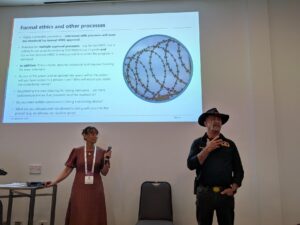
Image description: ARTD Senior Manager, Paula Shaw and Uncle Syl Johns presenting at AES26.
Finally, Annabel Prescott asked the question head on: who is evaluation data for? Emphasising that young people should see, keep and use their own results, so that measurement helps them to take ownership of their growth rather than being something taken from them.
Together, these sessions point to the importance of treating the people closest to a program as partners in understanding it. It changes what we ask, what we give back and what we count as success. Each session demonstrated the importance of walking alongside people impacted by programs to understand their experiences. Circling back to the theme of the day, this way of working is slower than working alone, but it leads to better evaluation.
Emily Gates closed the conference with her keynote on ethical reflexivity when “what’s right” is contested. Ethics, she suggested, is more than personal values or compliance with guidelines. In systemic change it is an ongoing, relational practice that asks us to hold space for hard questions and disagreement, and to notice how our role shifts when we evaluate systems instead of programs.
And that brought the conference to a close. As a returning AES delegate, it was interesting to experience the conference from a different perspective – with a little more context, more familiar faces, and a better sense of the conversations happening across the evaluation community. I left feeling inspired to be surrounded by so many people doing work to that enables us to travel far on the journey together.
A big congratulations to the newly appointed AES Fellows and award winners celebrated at the gala dinner. Thank you to the AES committee, and to Bill Wallace, Fiona Zlotnik and Sonya Krzywoszyja, for all the effort that goes into bringing us together.
See you in Brisbane for AES27!