AES Conference – Recap of Day 1
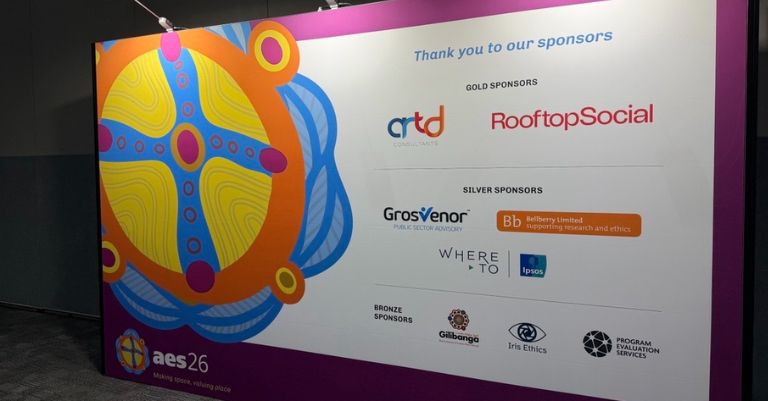
Several of our team are on Larrakia Country this week for the Australian Evaluation Society Conference. Whether you’re at the conference and couldn’t make every session, or following along from afar, we’ve got you covered!
In little surprise to anyone who knows me, day one of AES26 reminded me of the best bits of my philosophy/ gender studies degree, and something Nick Cave said about going to church.
The theme of the AES conference this year is Making Space, Valuing Place. This was picked up in various ways throughout the day: the role of context in knowledge creation, how to engage with different ways of knowing, attending to power dynamics, destabilising what we think of independence and its value, and more.
Dr Robyn Ober’s open plenary outlined the importance of being comfortable with discomfort, to open ourselves up to knowledge and wisdom we might otherwise miss. She shared that a key part of this is rethinking what rigour means, including how we can combine traditional knowledge systems and contemporary evaluation methodologies. Different approaches and histories form our world view. But, to properly understand things outside our context requires us to be vulnerable, it asks a “level of risk taking” to sit with different ways of knowing and understanding. We need to be comfortable with letting things go to let things in.
She expanded on this in three stories about when her expectations on a project were confounded, and the opportunities the divergence created. She spoke about how her and her team went with the flow, embraced the change, and found value in areas they hadn’t necessarily anticipated in their plan. Adopting a flexible and open position was core to this. In response to a question later, Dr Ober emphasised that there is no formula, you have to judge things as they come.
In 2003, Judith Butler unpacked “Violence, Mourning, Politics”. In this work they put forward that the disruption of our world view (in their context, political violence) exposes things often hidden: the “fiber of the boundary that contains me.” For them, when our world view is disrupted we find ourselves in a place of pain, vulnerability, and radical possibility. By recognising how much of our world view is “a relationality that is neither merely myself nor you, but the tie by which those terms are differentiated and related” Butler argues we are able to rebuild our understanding of the world rather than closing ourselves off from it.
Dr Ober modelled this in her talk. She told us parts of her personal history, and the history of her parents. She told us about the context of her upbringing, of her country, of the different kinds of education she had received and delivered throughout her life. In doing so, she introduced herself as a person, giving us context for why she might think a set way or take certain approaches.
As Butler would say, she made explicit her relationality.
Dr Ober’s talked about sitting in silence with communities on country to create a transformative space. It was a space to reflect, remember, think, and translate and interpret language accurately. As a basis for knowledge, negotiating language (written, spoken, gestured, or otherwise) is a complex and critical task to get right. Again I thought of my degree, and Western canon words like “epistemology” and “ontology” that had codified the world for me, and in doing so had in some way influenced how and where I find knowledge.
These ideas were picked up again later in Jo van Twest Farmer’s talk “The ethics of independence – what does independence evaluation mean in 2026?”. Twest Farmer spoke about the UN norms for evaluation, including the separation of behavioural independence and organisational independence. She did a temp check of the room, and found that most of the room identified themselves as independent evaluators. She troubled this idea, not just questioning whether impartiality is even possible in a value-laded discipline, but also whether independence is inherently valuable. The combination of these two is especially problematic – the illusion of objectivity through independence, if not noticed, actually keeps us from the relationships that create knowledge.
And, as she pointed out, evaluation already pushes against the sterile, objective stylings of “independence”. Methods like embedding lived experience or using place-based approaches highlight that abstraction away from the subject does not yield strong, deep knowledge – strong, deep knowledge exists by centering people who live within those spaces, who already have that knowledge and wisdom.
It reminded me of relational autonomy, an idea I came across in my gender studies. Relational autonomy pushes against the Western canonical understandings of individualised autonomy from thinkers like John Locke that formed the foundation of legal system. Relational autonomy asks us to notice how much of our lives are given over to one another, how much we rely on each other and have our worlds formed by our relationships, rather than being an island.
Or, as Butler would put it, “our relations with others holds us, in ways that we cannot always recount or explain, in ways that often interrupt the self-conscious account of ourselves we might try to provide, in ways that challenge the very notion of ourselves as autonomous and in control.”
Of course, pushing against established ways of knowing comes with risk – that the society we live in and its institutions, designed in the Western canon, will not be convinced by arguments from outside that framework. For our work to inform future changes, it needs to convince these same institutions. None of us can escape the trappings of our environment, the way our world is held up by its history, and which ways of knowing are privileged
After a full day of chewing on this thought, I went to the excellent Ignite sessions – 5-minute, rapid fire presentations where a group of evaluators watch a clock tick down and try to cram their considerable knowledge into a tiny window. There were many strong speakers, as there have been throughout the day. But my colleague Amanda Taylor-Short offered a wonderful salve to my anxiety: the pub test.
The pub test approach asks a pretty simple set of questions: does it make sense, is it honest, is it dodgy? If yes to any of these, it won’t pass the pub test. As Amanda said, ultimately our work is often commissioned using public money for the public good, so shouldn’t it be answerable to the public? All the technical expertise and information should amount to an answer accountable to this test. It seemed so reasonable that I can’t imagine anyone pushing back on the grounds of epistemology or ontology or any of the other long words I learnt in my degree. If it’s for public good, it needs to pass common sense.
Nick Cave says that when he goes to church he starts in a position of extreme scepticism, and over the course of service feels all his bitterness, reservation, and doubt washed away by belief. I am not a religious person, but I have my own scepticism about knowledge, about the value of theory, about whether talking about and writing about ideas actually gets us anywhere to a better future. Call it a perverse byproduct of too long studying philosophy. But, I felt that scepticism washed away today as I heard brilliant people speak with truth and wisdom about better ways we can understand the world around us, and watched curious people around me resonate with it and pick it up in their own conversations. It is nice to have scepticism defeated.